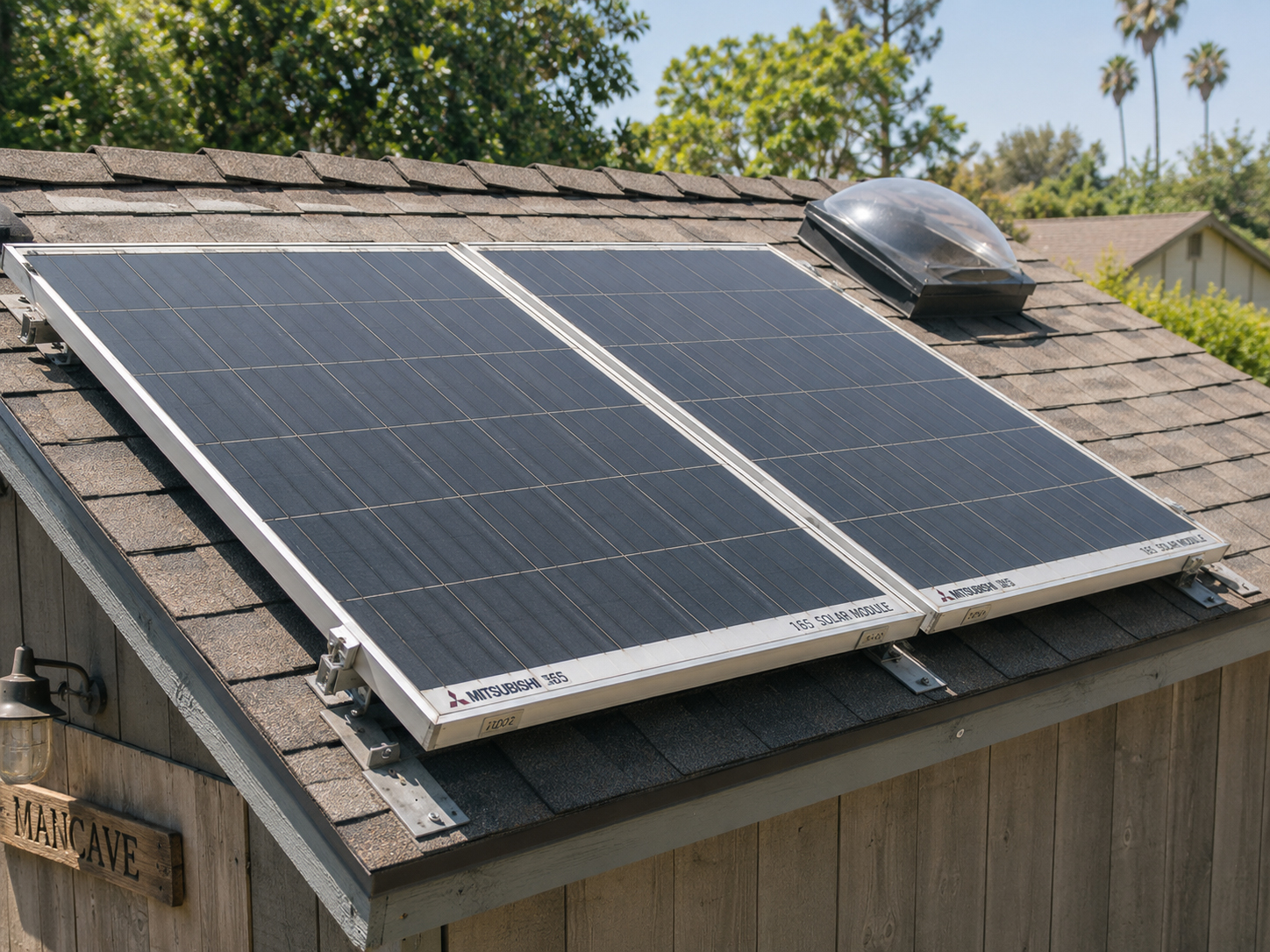
2002 Mitsubishi Panels
The roof-mounted legacy panels show the durability and long service life of solar equipment.
Open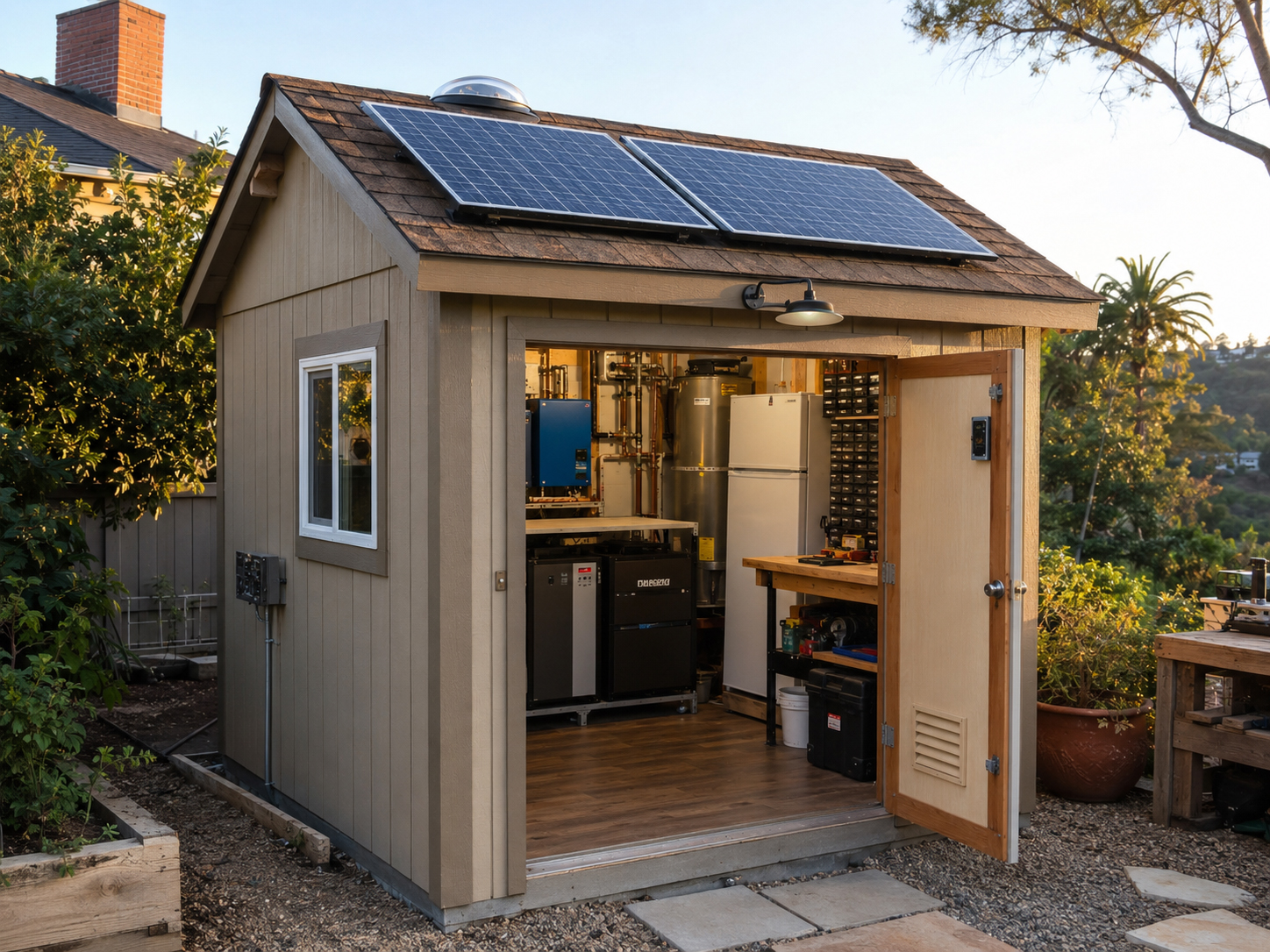
Where the legend started
A small backyard shed became a compact renewable-energy laboratory: solar panels, battery backup, DC refrigeration, thermal storage, hot-tub experiments, fish ponds, soil heating, and off-grid fire-protection thinking.
Small footprint, big experiment
The original Solar Man Cave was an 8' x 10' shed, but the mission was much larger than the footprint. It became a working ABC Solar research and development center where renewable-energy ideas could be connected, tested, observed, and improved.
This is the real foundation of SolarManCave.com. The modern manga version turns battery backup into comedy, but the site begins with practical experimentation: what can a small solar-powered room actually support?
A small shed forces discipline. There is no room for vague theory. Every component must earn its space. Every wire, battery, tank, pump, refrigerator, control box, and pipe has to fit into a working system.
That made the Solar Man Cave useful. It was small enough to understand, but complete enough to reveal the real questions behind solar power:
Make the solar system visible. Make the loads understandable. Make the experiment small enough to touch and big enough to teach.
The roof of the shed held two legacy 165-watt Mitsubishi solar panels from 2002. They were modest by modern panel standards, but important as proof of durability and long-term production.
Those panels charged a battery bank connected to an older 2000-watt inverter. That setup turned the shed into a small but real off-grid learning environment. It was not a showroom. It was a working laboratory.
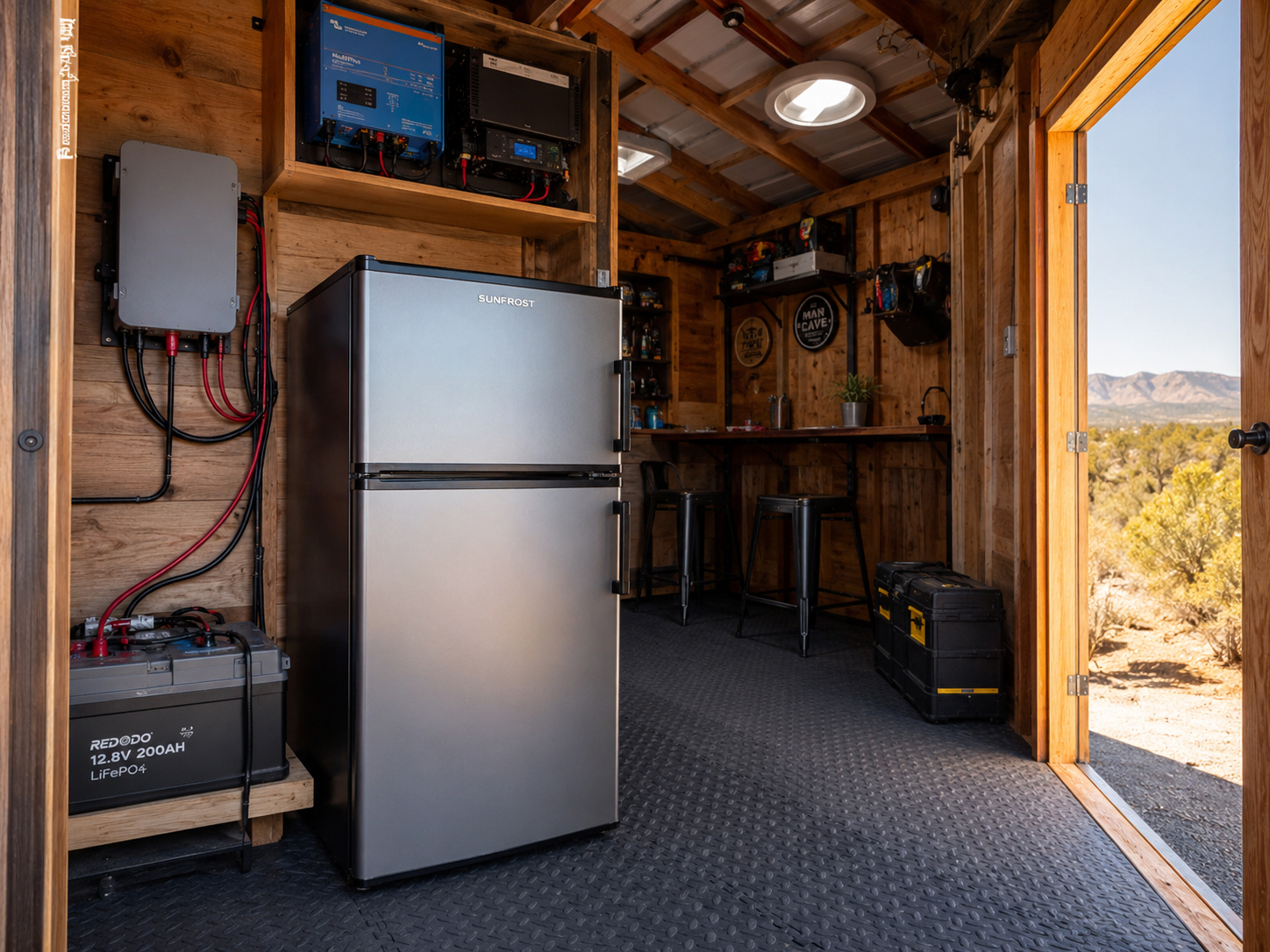
Inside the shed, the system was built around practical loads. One of the most important was the SunFrost DC refrigerator/freezer. Refrigeration is one of the clearest ways to understand backup power because the value is obvious: food stays cold, medicine can be protected, and essential storage continues when the grid fails.
That practical DC refrigerator is the serious ancestor of the modern Solar Man Cave mini-fridge comedy. The joke says the snack fridge is emotionally critical. The real engineering point is that refrigeration is a protected load people understand instantly.
Solar Man Cave was not only about PV and batteries. It also explored solar thermal energy: storage tanks, collectors, heat exchange, pumps, and circulation.
The hot tub system gave the experiment a human dimension. It connected sunlight to comfort. It also showed that solar design is broader than electricity. Heat, water, circulation, filtration, pumps, and storage all belong in the conversation.
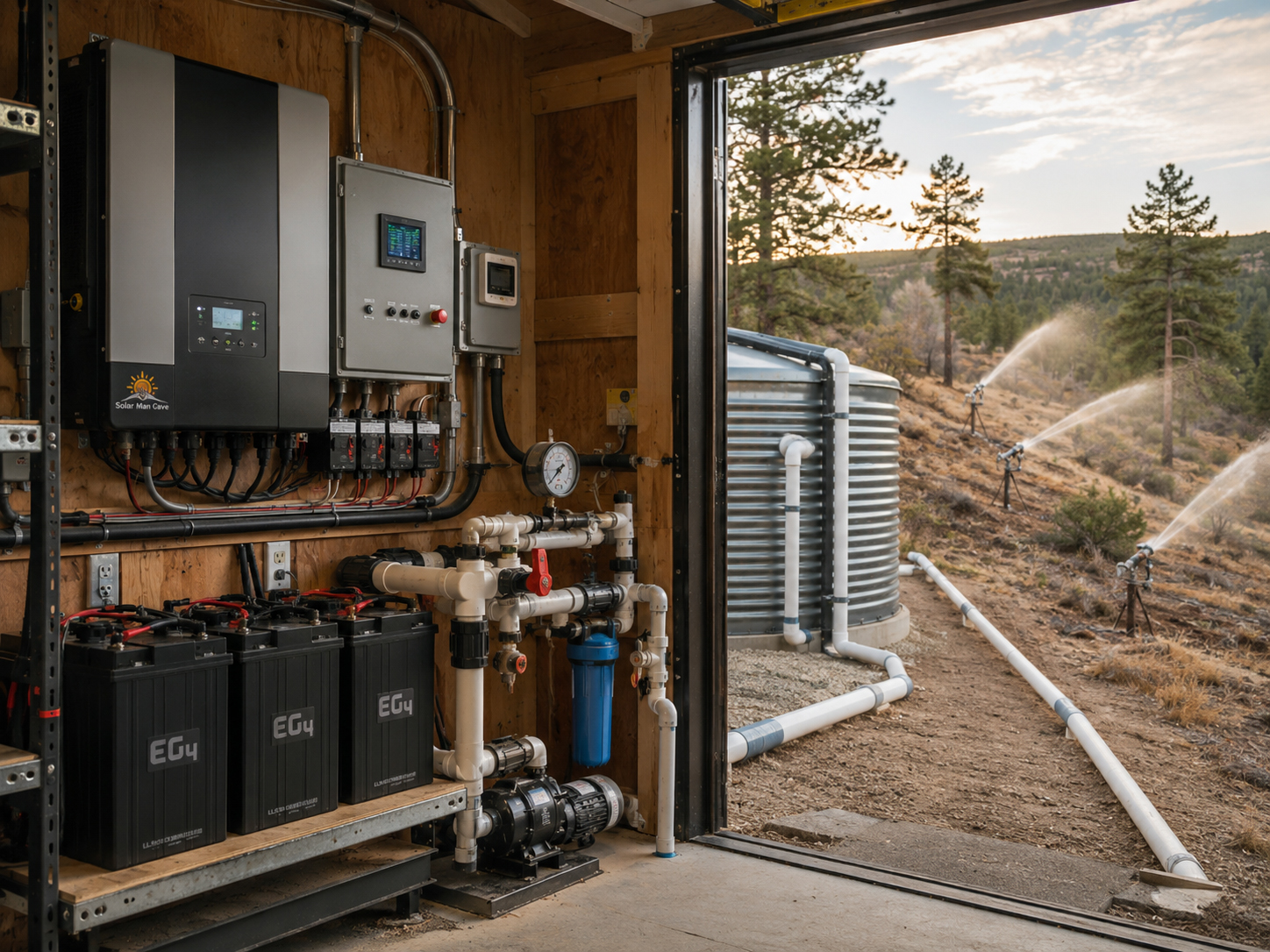
The most serious evolution of the Solar Man Cave was its use as a control and power hub for off-grid fire-protection thinking. A shed that began as a solar laboratory could also support pressure, valves, pump controls, battery storage, water delivery, and remotely controlled sprinkler concepts.
This is why the story matters. Solar backup is not only about convenience. It can support safety, water movement, communications, refrigeration, lighting, and essential control systems.
The 8' x 10' shed proved a larger idea: solar is not just a panel on a roof. Solar is a system of useful work.
The new SolarManCave.com keeps this history and adds a manga layer to make the lessons easier to remember. Captain Recliner, Madame Kilowatt, Tomoko Reality Check, the Permit Goblin, and the SCE Rate Tantrum all point back to the same practical question:
What do you actually want to keep running?
The real shed answered that question with panels, batteries, a DC fridge, thermal storage, pumps, and controls. The manga version answers it with a recliner, snacks, a mini-fridge, Wi-Fi, gaming, home theater, and a battery wall. Different tone. Same solar lesson.
Solar Man Cave began as a compact ABC Solar experiment. The new site should honor that origin while using humor to explain backup power, protected loads, and resilience.
Continue the R&D trail
Each Solar Man Cave page should trace back to this origin: real equipment, real loads, real experiments, and then a memorable manga explanation.
ABC Solar Incorporated
Solar Man Cave turns the protected-load conversation into something people can see: panels, batteries, refrigeration, hot water, pumps, lights, and comfort.