Battery Wall
Tantrum Shield
Protected Loads
The wall that keeps the cave alive
Battery Wall Protecting the Man Cave
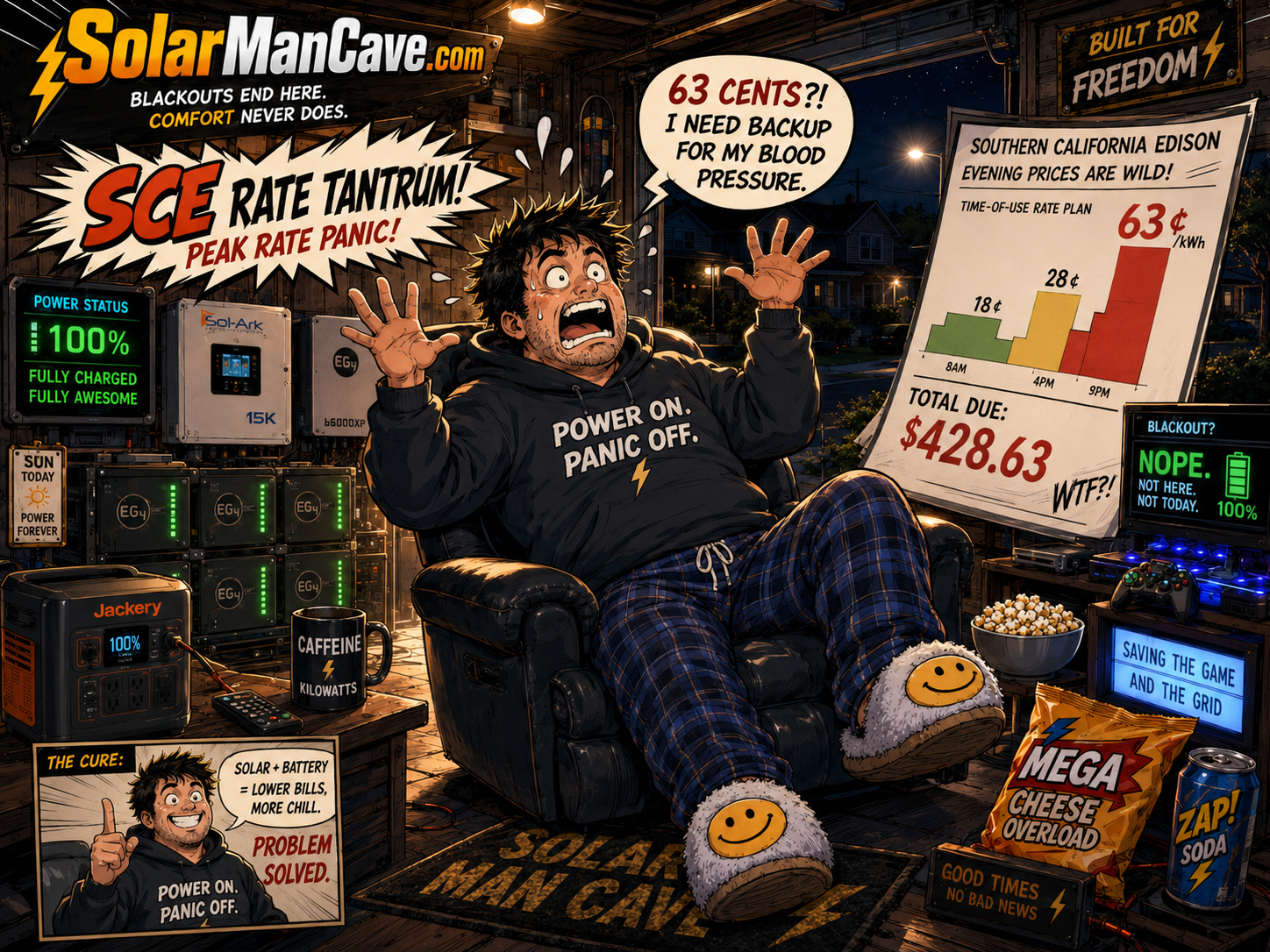
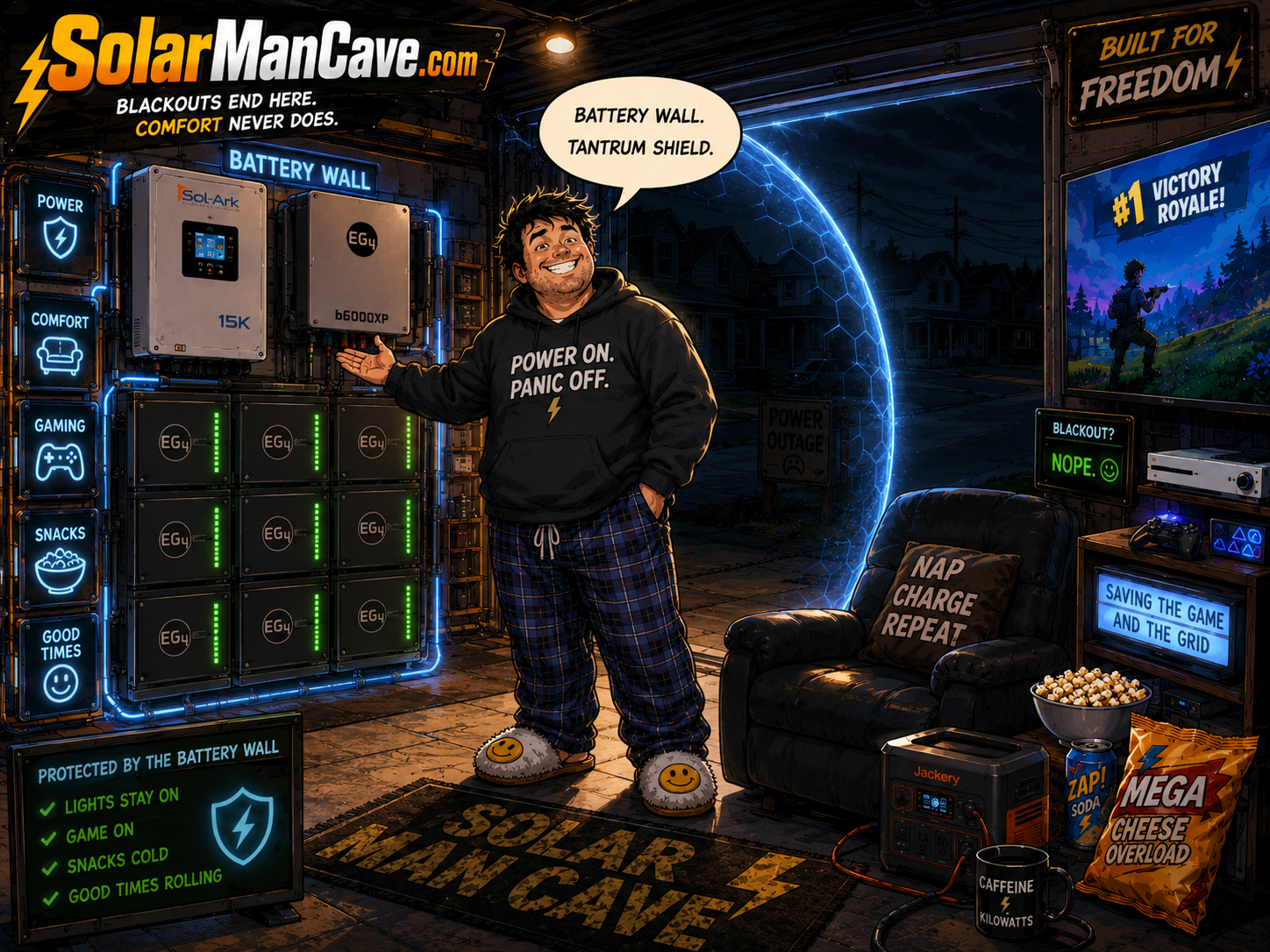
The battery wall is the Solar Man Cave defense system: lights stay on, snacks stay cold, Wi-Fi stays alive, the screen keeps glowing, and the cave survives blackouts and peak-rate attacks with dignity.
The tantrum shield
The battery wall is not decoration. It is the promise.
In the Solar Man Cave manga universe, the battery wall is dramatic. It glows. It looks powerful. It stands between the cave and the dark neighborhood outside. It protects the recliner, the lights, the mini-fridge, the Wi-Fi, the game room, the home theater, and the owner’s fragile emotional relationship with utility bills.
But under the comedy, the battery wall has a serious job. It must support the loads it promises to protect. That means the design cannot be vague. The load list, inverter capacity, battery capacity, circuit selection, and solar recharge all have to match.
What the wall protects.
A Solar Man Cave battery wall is not a magic “everything forever” machine. It is a storage system designed to protect selected loads for a realistic amount of time. The key word is selected.
- Refrigeration and cold storage.
- Wi-Fi, modem, router, and communications gear.
- Selected lighting circuits.
- Garage tools, chargers, or access equipment.
- Home office or computer loads.
- Pumps, controls, or fire-resilience equipment where applicable.
- Comfort loads such as TV, gaming, theater, or mini-fridge when properly sized.
Solar Man Cave translation
Technical version: protected-load panel, inverter sizing, battery capacity, PV recharge, runtime modeling, and circuit priority.
Cave version: what stays on when the rest of the house goes dark?
The battery wall fights two enemies.
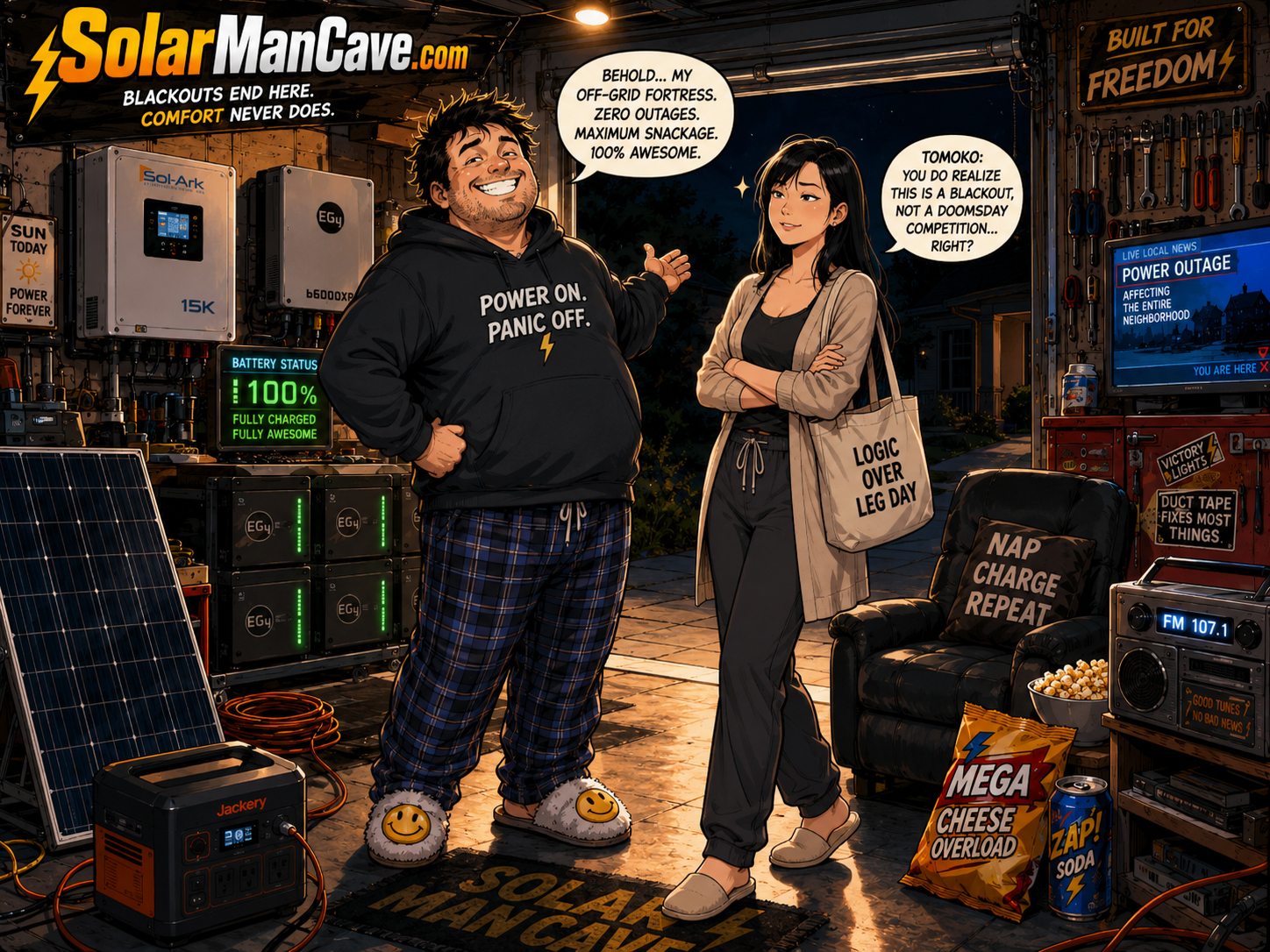
The first enemy is the blackout. The grid fails, and the protected loads need stored energy. That is the dramatic manga moment: the neighborhood is dark, but the cave still glows.
The second enemy is timing. Electricity can be painful during peak-rate periods. Solar produces during the day, but household use often rises later. A properly designed battery system can help move solar value into the hours when the customer needs it more.
Blackouts are a power problem. Peak rates are a timing problem. Batteries can help with both.
Runtime is the truth test.
Every battery backup conversation eventually reaches runtime. How long should the system last? One hour? One evening? Overnight? Through a multi-day outage? The answer changes the system.
The Solar Man Cave makes runtime easy to visualize. If the cave owner wants the refrigerator, Wi-Fi, lights, gaming room, home theater, tool chargers, and mini-fridge all running together, the battery has to carry all of that. If the outage lasts, the owner may need to choose.
- Short outage: comfort loads may stay on.
- Long outage: essential loads may outrank entertainment.
- Night outage: the battery carries the load without solar recharge.
- Cloudy weather: recharge assumptions must be conservative.
- High-draw loads: runtime drops quickly.
The wall needs discipline.
A battery wall can look impressive and still be poorly matched to the customer’s expectations. That is why the Solar Man Cave story should always return to design discipline. What is protected? What is not protected? What is the expected runtime? What happens when the battery gets low?
Good backup design should tell the truth before the outage does.
The serious design rule
Do not let the cave owner’s wish list become the protected-load panel by accident. Decide, size, label, and explain.
The real Solar Man Cave connection.
The original 8' x 10' Solar Man Cave already proved the battery story in miniature. Solar panels charged batteries. Batteries supported loads. The system powered refrigeration, controls, pumps, thermal experiments, and resilience ideas.
The manga battery wall is the modern, exaggerated version of the same lesson. Stored solar energy becomes useful only when it is connected to specific work.
A battery is not the goal. Useful powered work is the goal.
Why this page matters.
The battery wall page should be one of the core pages of SolarManCave.com because it ties everything together. The recliner king wants comfort. Madame Kilowatt creates cost pressure. The Permit Goblin asks for load proof. Tomoko demands honesty. The original R&D shed supplies credibility.
The battery wall answers with the real system question: what loads are protected, how long can they run, and how will the solar recharge the storage?
The page takeaway
The battery wall is the Solar Man Cave tantrum shield, but it only works when the protected-load list is honest and the system is sized for reality.
More battery-wall lessons
The wall protects the cave, but the load list protects the battery.
Each page turns one comfort joke into one practical battery design decision.